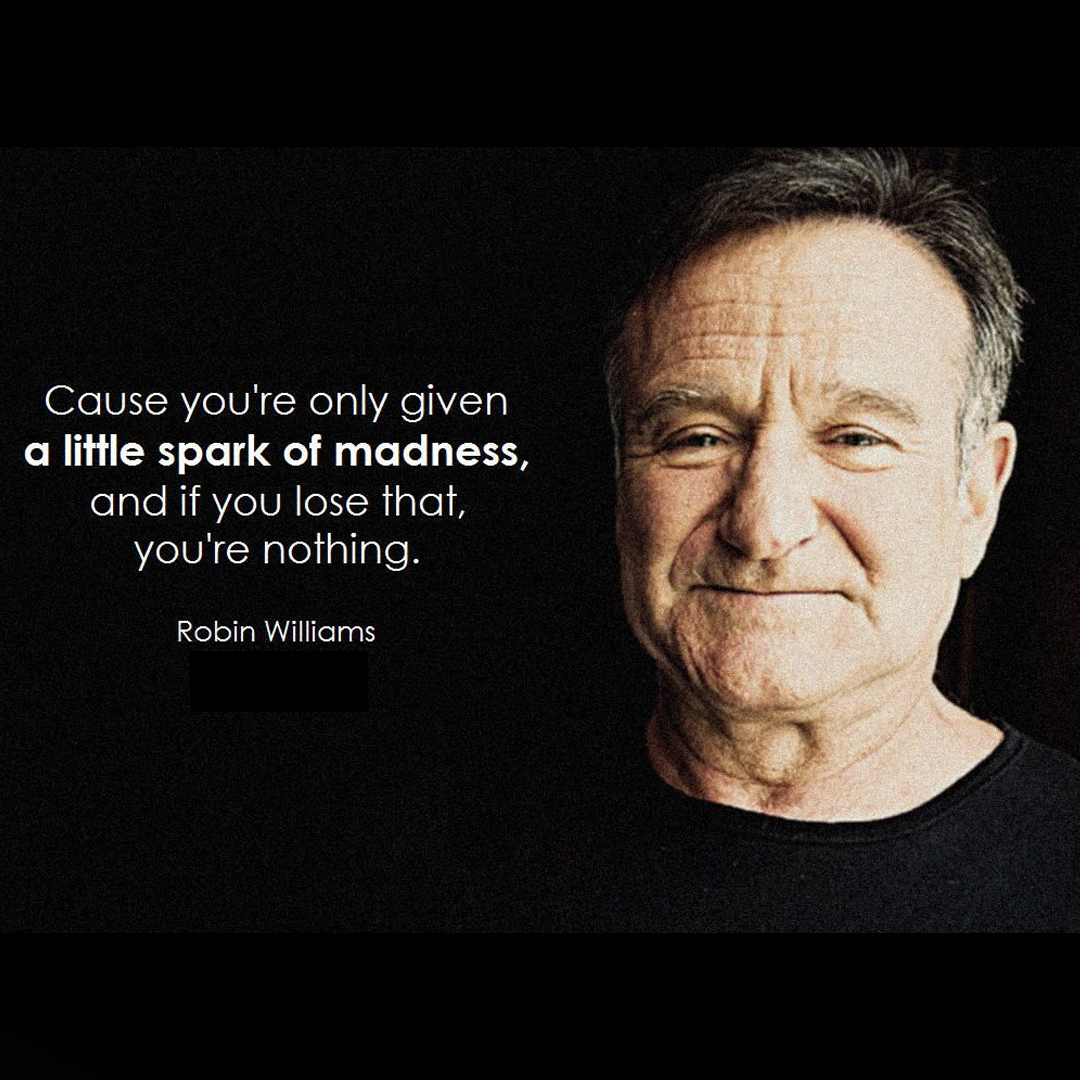
The Spark Doctrine
You’re only given a little spark of madness.
Guard it like it’s the only thing that’s actually yours — because it is.
I wasn’t looking for anything profound. I fell down a rabbit hole watching a Robin Williams clip — a bit from a performance called “Full Tilt Bozo” — and then I couldn’t move for ten minutes.
He’s doing a character. He’s being ridiculous. And then, right in the middle of all of it, he says something that cut straight through me:
“You’re only given a little spark of madness. And if you lose that, you’re nothing.”
— Robin Williams, Full Tilt Bozo
Then he quotes Lord Buckley — an underground comedian from the 1940s who nobody knows but everybody should — who said people are kind of like flowers, and it’s been a privilege pollinating their garden. And then Williams says the thing that really got me: there’s no way any government in the world can handle madness. Because when you’re mad — truly mad — you get to fly above it all. And that angels have wings because they take themselves lightly.
I’ve been saying versions of this my whole life. Jimmy Hendrix said craziness is like heaven. Jordan Peterson talks about how the jester — the fool — is the freest person in the room because he’s already surrendered the one thing everyone else is desperately protecting. I just didn’t have a name for it until now.
This is the Spark Doctrine. It’s what I believe. It’s how I work. It might be the most important thing I’ve ever written down.
1. Guard the spark above everything else.
The world doesn’t run out of ways to kill it. Systems. Processes. The need to be taken seriously. The fear of what someone might think. Respectability. The mortgage. The meeting. The inbox. One by one, they sand down the edges until you’re smooth and professional and completely forgettable.
The spark is the thing that makes your work undeniably yours. It’s the reason people remember a conversation with you six months later and can’t exactly explain why. It’s the thing that sounds crazy right up until the moment it’s obviously right. Guard it like your life depends on it — because in every way that actually matters, it does.
2. Take the work seriously. Take yourself lightly.
Williams said it in the most Williams way possible: angels have wings because they take themselves lightly. He wasn’t being cute. That’s the actual formula.
The people who float above the noise aren’t the most serious ones in the room. They’re the most unencumbered. They’ve let go of the weight that keeps everyone else earthbound — the ego weight, the reputation weight, the constant calculating of how this looks. When you’re not carrying all of that, you can actually move. You can say the true thing. You can be ridiculous when ridiculous is right and dead serious when serious is required, and you can tell the difference without overthinking it.
Caring deeply about the work and caring deeply about your image are not the same thing. One gives you wings. The other is an anchor wearing a suit.
3. The jester is the freest person in the room.
Peterson talks about this — the fool, the jester, the one who acts like none of the rules apply to him. People think that’s weakness. It’s the opposite. In King Lear, every serious character eventually breaks, lies, betrays, or collapses under the pressure of having too much to lose. The Fool just keeps telling the truth the whole time. The whole play. He’s the only one who does.
He can do it because he’s already been written off. He holds no position worth protecting. He has no reputation carefully maintained over years that could shatter with one wrong move. So he gets to say the thing nobody else will say.
Every time I’ve been most useful to someone — in a meeting, in a conversation, in a piece of work — it wasn’t because I said the polished, careful thing. It was because I said the true thing. You can only do that when you’re not afraid of what it costs you.
4. People are flowers. You’re a pollinator.
This is Lord Buckley’s line, passed through Robin Williams like a torch. And it changes how you think about every interaction you have — professional or personal.
Show up. Give what you have. Leave the garden better than you found it. And then trust — completely trust — that when you come back, it’ll still be growing. No grasping. No attachment to credit. No desperate need to know what happened after you left. You don’t own the flowers. You just helped them bloom.
That’s it. That’s the whole relationship philosophy. That’s the whole business philosophy. That’s the whole life philosophy, if you let it be.
The people who work this way — Buckley worked this way, Williams worked this way — they fill rooms. Not because they’re trying to. Because giving without grasping is so rare that people can’t stop coming back toward it.
5.Crazy is the only way to stay honest.
Here’s what Williams was really saying about governments and madness: the systems of the world are built to manage people. To keep them predictable. To make them easy to handle. And sanity — proper, respectable, careful sanity — is highly manageable. You can negotiate with it. You can contain it. You can make it do what you need.
Madness you cannot manage. Madness flies above. Madness says what it sees. Madness makes art that makes people cry in the dark and doesn’t fully understand why. Madness builds things that shouldn’t work and then stands there confused when they do.
Every time you’re tempted to soften the true thing — to make it more palatable, to hedge, to manage how it lands — that’s the sane voice taking over. The mad voice says it anyway. The mad voice is the one people actually remember.
The part nobody talks about.
Here’s what I won’t leave out because it would be dishonest: this costs something.
Lord Buckley died obscure and broke. Hendrix burned out at 27. Williams fought for decades with the weight of his own brilliance and eventually lost. The spark doesn’t come with a warranty. It doesn’t guarantee comfort or stability or a clean ending. The people who guarded it most ferociously often paid the highest prices for doing so.
I’m not romanticizing that. I’m acknowledging it because you can’t talk about the spark honestly without talking about what it demands.
But here’s the other side: look at what they left behind. Look at what Dead Poets Society does to a person. Look at what “Purple Haze” does to a person. Look at what Buckley’s “The Naz” does to a person if they ever find it. The work outlives everything. The spark they guarded — even at cost — is still warm decades later. You can still feel it. I felt it yesterday watching a clip from a performance from forty years ago.
The alternative — playing it safe, managing your image, sanding down the edges — also costs everything. It just costs it quietly, over time, where nobody can see it happening. Including you.
Given those two options, I know which one I’m choosing.
The Doctrine, distilled
- 1Guard the spark. It’s the only thing that’s actually yours. Everything else is borrowed.
- 2Take the work seriously. Take yourself lightly. That’s the wing formula. That’s how you fly.
- 3The jester is the freest person in the room. He’s already surrendered the thing everyone else is protecting. That’s not a liability — that’s the whole advantage.
- 4People are flowers. Be the pollinator. Show up. Give everything. Leave the garden better. Trust that it’ll still be there when you come back.
- 5Crazy is the only way to stay honest. Every time you soften the true thing, the sane voice wins. Don’t let it.
Williams, Buckley, Hendrix, Peterson, and everyone else who’s ever said “stay mad” in whatever language they had for it — they’re all pointing at the same thing.
The spark is not the obstacle. It’s the credential.
Don’t lose it. From me to you.